Vikram-1 lifted off on July 18, 2026. Fifteen minutes later, it reached orbit. That single flight made history. India became the third country with a privately built rocket that can reach space on its own. The rocket was built by Skyroot Aerospace, a Hyderabad startup. The company is just eight years old.
Vikram-1 climbed off the First Launch Pad at the Satish Dhawan Space Centre in Sriharikota. Liftoff came at 12:05 p.m. IST. The mission had a fitting name: Aagaman, Sanskrit for “the arrival.” It truly was an arrival. Not just for one company, but for an entire industry. India had spent years trying to build that industry.

Skyroot Aerospace’s Vikram-S rocket lifts off during Mission Prarambh in November 2022, the suborbital flight that paved the way for Vikram-1. (Image: Wikimedia Commons)
Where Vikram-1 Began
The Vikram-1 story does not start on the launch pad. It starts in 2018, in Hyderabad. Two former ISRO scientists, Pawan Kumar Chandana and Naga Bharath Daka, felt India needed more than one route into orbit. So they founded Skyroot Aerospace. Their goal was bold. They wanted to build India’s first fully private orbital rocket. That meant everything: the carbon-composite body, the engines, and the guidance software.
For years, that goal looked like a long shot. Rockets are expensive. Space is unforgiving. However, two things worked in Skyroot’s favour. The first was timing. In 2020, India opened its space sector to private companies. This was backed by a new regulator called IN-SPACe. The second was proof. In November 2022, Skyroot’s suborbital rocket, Vikram-S, reached space. The mission was called Prarambh, meaning “beginning.” It was a short flight. But it was the first rung on a very tall ladder.
Building an Orbital Rocket From Scratch
What followed was years of demanding work. Skyroot built and tested solid rocket motors. It named them after Indian scientific icons: Kalam-1200, Kalam-250, and Kalam-100. It added a liquid-fuelled fourth stage. That stage used Raman engines for precise orbital insertion. And it built the whole airframe from carbon composite. This made Vikram-1 lighter and, Skyroot says, faster to build than a metal rocket.
To support this pace, Skyroot opened an “Infinity Campus” in Hyderabad. The stated goal was bold: build one orbital rocket every month. That is a factory mindset, not a government-lab mindset. In November 2025, Prime Minister Narendra Modi inaugurated the campus. He unveiled the flight-ready Vikram-1 at the same event. Former ISRO chairman S. Somanath later joined Skyroot too. He became an honorary advisor. That gave the young company real institutional weight.

Skyroot Aerospace’s Infinity Campus in Hyderabad, where the flight-ready Vikram-1 was unveiled in November 2025. (Image: Wikimedia Commons)
A Launch Window Under Pressure
By July 2026, the stakes were higher than usual. ISRO, India’s state space agency, had just suffered two consecutive launch failures. As a result, Skyroot’s window carried extra weight. That window ran from July 12 to August 4. Fairly or not, it became a test. Could India’s private space push deliver where the old guard had stumbled?
Launch day had a brief delay. Vikram-1 finally lifted off at 0635 GMT. It carried Skyroot’s own SCOPE satellite, built to record flight data. It also carried two symbolic payloads. One was an 18-karat gold miniature rocket. The other was a lab-grown-diamond sculpture called “Cosmic Bloom.” Fifteen minutes after liftoff, the fourth stage did its job. It placed the payloads into a roughly 450-kilometre orbit. The control room erupted. “The Vikram-1 Aagaman mission is a grand success,” the mission director announced.
Why This Arrival Matters
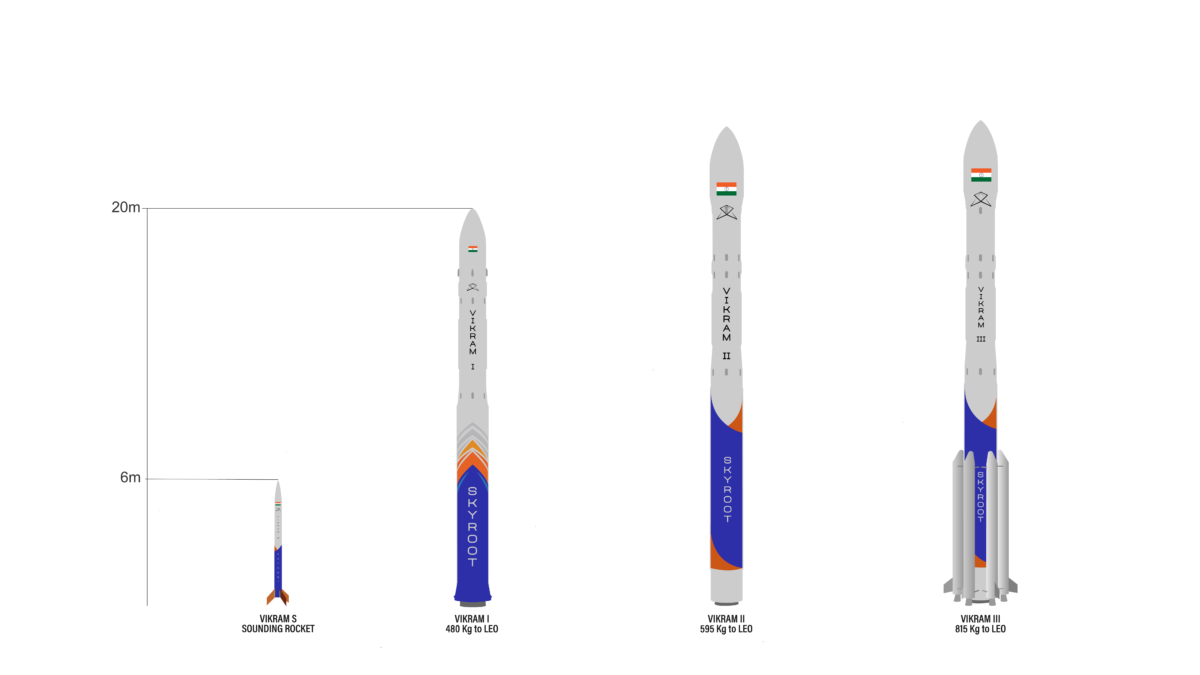
Vikram-1 is not a large rocket by global standards. It can carry up to about 480 kilograms to low Earth orbit. That puts it in the small-satellite category, not the heavy-lift class. But size was never really the point here. Ownership was the point. An Indian company built the engines. It built the avionics. It built the airframe. Then it flew that rocket from a private factory floor to a stable orbit, with no government launch vehicle doing the work.
That achievement puts India in rare company. Only the United States and China share it. In each, a privately developed rocket has reached orbit. The timing matters too. Startups worldwide are racing to challenge SpaceX’s grip on the small-satellite launch market. Skyroot itself crossed a billion-dollar valuation earlier in 2026. It became the first Indian space company to do so.
How India Got Here
None of this happened by accident. For decades, ISRO held a near-monopoly on Indian rocketry. That made sense in the 1960s. Space technology was scarce and strategic back then. But by the 2010s, it had become a bottleneck. Private satellite operators, Indian and foreign alike, often faced long queues. There was only one launch provider to book.
The 2020 reforms changed that picture. They let private companies build, own, and fly rockets. They were no longer limited to supplying parts to ISRO. IN-SPACe was set up as a single-window regulator. It handles licensing. It handles safety clearances. It manages access to government launch pads. Skyroot was one of the first companies to use this new framework. Rivals like Agnikul Cosmos followed the same path. In many ways, Vikram-1’s success is a report card for that whole policy shift.
It also carries weight beyond India’s borders. Small satellite operators everywhere want more launch providers, not fewer. A single dominant player, however capable, means higher prices. It also means longer queues. Vikram-1 gives global customers a new, credible option. This one is built in Hyderabad, not Texas or California.
What Comes Next: Vikram-II
Skyroot is not slowing down. The company is already developing Vikram-II. This larger rocket is designed to carry roughly 900 kilograms to low Earth orbit. It will use an upgraded cryogenic upper stage. Eventually, it may use 3D-printed propulsion parts too. Vikram-1 proved a private Indian company could reach orbit at all. Vikram-II aims to prove it can do so at commercial scale.
For now, the story belongs to one Saturday afternoon over the Bay of Bengal. A carbon-composite rocket rose off a pad it shares with ISRO’s own history. It carried a satellite, a golden trinket, and eight years of private ambition. India’s space programme has always found ways to do more with less. Vikram-1 suggests the next chapter may be written in a startup’s factory, not a government lab.
For more stories on India’s technology and innovation landscape, visit BhagatSingh. For further background on the wider ecosystem, see Wikipedia.